
Meet Yopo, Ayahuasca's Grandfather: the Sacred Plant No One's Heard Of.
By Stevan Sipka, Ethnobotanist & Founder of Sacred Plants Australia
Ayahuasca has a grandfather. You've never heard of him.
His name is Yopo. If you have spent years in the plant medicine world and still never encountered this name, that gap is precisely why this piece exists.
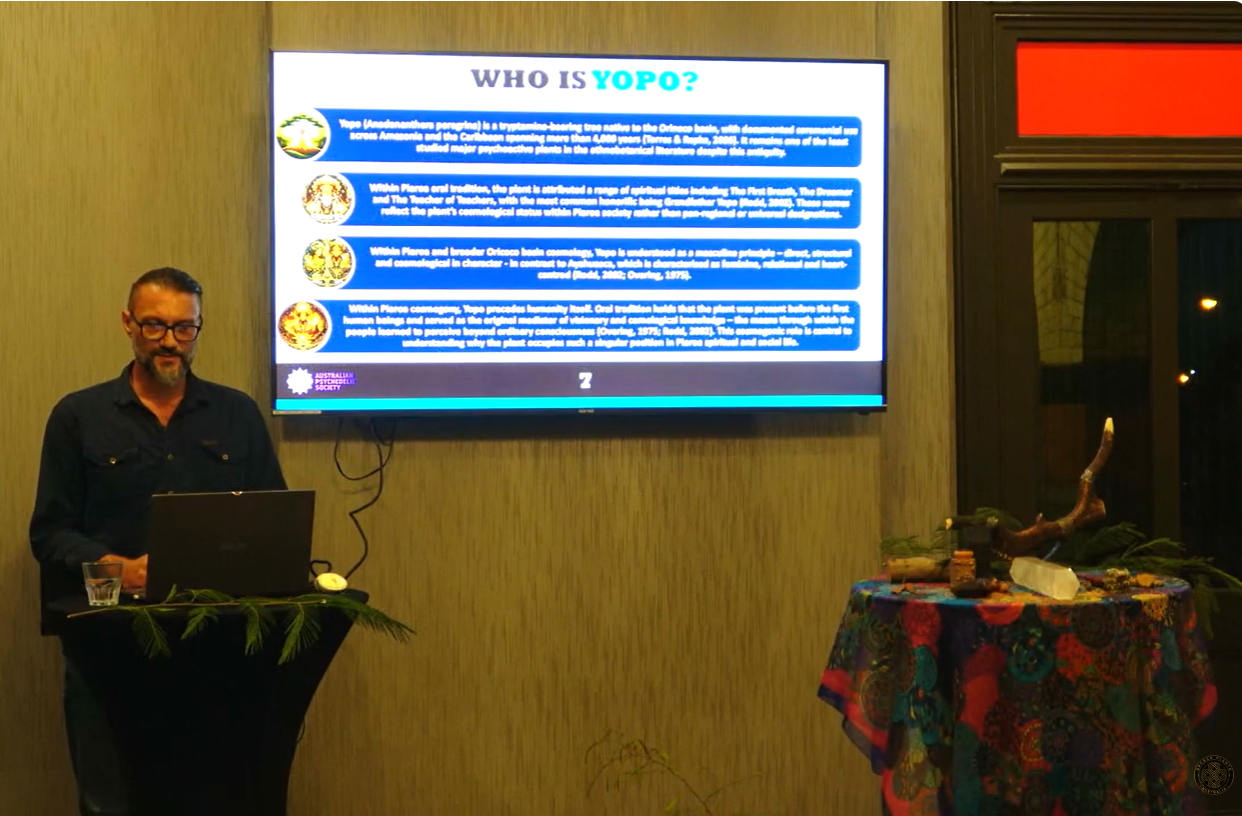
Stevan Sipka presenting on Yopo for the APS’s Brisbane chapter.
The Tree
Anadenanthera peregrina grows tall across the savannahs and gallery forests of the Orinoco basin. He has a striking presence. Mature trees reach 20m, or 65ft, broad-canopied, deeply rooted in the soils of Venezuela and Colombia, his long seed pods splitting open in the dry season to reveal dark, disc-shaped seeds. Carrying within them a chemistry so unique, so precise, so pharmacologically extraordinary, that the peoples who discovered it thousands of years ago built an entire civilization with Yopo at its very centre.
Snail shells are gathered with care and calcined until they convert through fire into a fine, water-soluble, alkaline powder. Then the sacred ash of Yopo's own tree bark is added. These two substances are combined with the roasted and shelled seeds and worked together into a paste until the result is a fine, dark medicine whose chemistry Western science has now confirmed. The high pH free-bases the active compounds, liberating them from the seed matrix in a form the body can fully receive. The Piaroa did not arrive at this through trial and error in any sense we would recognise. Yopo taught their creator god Wahari through visions, who then taught them.
But here is what Western chemistry does not account for. Within Piaroa understanding the snail is not merely a source of alkaline material. The snail carries its own consciousness. When the shells are converted and worked into the medicine, that consciousness enters the preparation, slowing the experience down. What is insufflated is not a cocktail of extracted compounds. It is a meeting of sacred intelligences. The seed, the snail, the sacred ash, and the Yoponero brought into relationship through sacred ritual and the accumulated knowledge of 4,000 years.
Somewhere in the Orinoco basin right now, a Yoponero is doing exactly this. As they have done every generation, across every century, across every upheaval history has thrown at them. That continuity is almost incomprehensible. Almost no one outside the Orinoco knows it exists.
The Grandfather
Within Piaroa cosmology Yopo holds the highest position in the sacred plant lineage. He is the Sky Grandfather. The First Breath. The Dreamer. The Teacher of Teachers. The masculine structural principle at the head of a cosmological order that understands plants not as resources but as ancestors, not as compounds but as teachers, not as substances to be extracted but as beings whose knowledge constitutes the deepest levels of cosmic wisdom.
And Ayahuasca? Within Piaroa oral tradition she is Yopo's granddaughter. He taught her all of her songs. He was here first. For once the archaeology agrees. Documented ceremonial use of Yopo at Inca Cueva in Argentina dates to 2,000 BCE. The earliest confirmed evidence of Ayahuasca preparation, a ritual bundle recovered from Cueva del Chileno in Bolivia, dates to around 1,000 CE. Yopo preceded Ayahuasca by 3,000 years. The lineage runs exactly as the Piaroa have always said it does.
The Yoponero
The ceremonial specialist who works with Yopo is called the Yoponero, a Spanish term drawn from the plant's own name to describe the person who holds this sacred relationship. Within Piaroa tradition there are two levels of this shamanic mastery. The Meyeruwae, the Owner of Songs, heals through the sacred chants whose knowledge was transmitted through vision and whose recitation maintains the health and balance of the community. Above him stands the Yuhuaruwae, the Owner of Yopo, a type of Grand Shaman distinguished by greater powers of diagnosis, divination and the capacity to wage war in the spirit realm on behalf of his people. Both undergo extensive years of shamanic apprenticeship, the same three initiatory ordeals of biting ants, wasp stings, and the piercing of their own tongue with a stingray barb. Both work intimately with Yopo across a lifetime of practice. What separates them is what opens on the other side of that apprenticeship and what each is prepared to do with it.
This is not a tradition that can be entered in a weekend. The knowledge does not come from a course or a credential. It comes from an unbroken chain of living transmission reaching back to the beginning of time. What the Yoponero holds is not just wisdom. It is relationship. The distinction matters enormously and is one the Western psychedelic world, for all its recent progress, has not yet fully grasped.
The Medicine
The primary visionary compound in Yopo is bufotenin, or 5-HO-DMT. Not DMT, though that confusion is near-universal in Western discourse and it matters deeply. Alongside bufotenin, the seeds carry DMT and 5-MeO-DMT. Before insufflation the Piaroa chew on Banisteriopsis caapi vine, whose beta-carboline alkaloids act as an MAOI, potentiating and deepening what follows in ways that Western pharmacology is only beginning to understand. It is a pharmacological architecture of extraordinary refinement, and it carries within it a safety warning for how we approach this medicine in the West.
The experience itself is not comparable to Ayahuasca. Not comparable to psilocybin. Not comparable to the Toad. Not comparable to anything already in the Western psychedelic canon. The onset is immediate. The peak is total. After insufflation the experience resolves within 40 to 60 minutes.
Where Ayahuasca takes you down a long river over hours, through memory and emotion and gradual revelation, Yopo is a direct transmission from the sky. Structural. Absolute. Leaving no room for anything except to be held by the divine and to receive.
Where mushrooms offer a curious conversation, Yopo is a briefing from the architect of reality itself.
The Piaroa have always known this. It is why the ceremony is what it is. It is why the Yoponero exists and the role is so demanding. You do not approach something this ancient, this direct, this powerful without the container and a master at the helm that thousands of years of refinement crafted to hold it.
The Silence Is Deafening
We are living through a genuine psychedelic renaissance. Psilocybin is moving through clinical trials and legislative chambers. Ayahuasca has entered mainstream consciousness. MDMA-assisted therapy has been peer-reviewed, debated, legislated. Billions of dollars and the full weight of Western medicine have turned toward these medicines and the results have been extraordinary. People are healing from things that decades of conventional therapy could not touch.
And yet Yopo, the oldest of them all, the grandfather of the entire lineage, the medicine with the longest unbroken ceremonial record in the world, has been passed over almost entirely. There is no clinical trial. There are no documentaries. No podcasts. There is no widely read account of his ceremony, his cosmology, or what generations of unbroken relationship with him has produced in the peoples who have carried him across millennia.
But perhaps this is not an oversight. Perhaps it is divine timing.
The world was not ready for Yopo. It needed two decades with other sacred plant medicines first. It needed to build the language, the humility, the frameworks and the cultural readiness before it could approach something this ancient and this cosmological. Grandfather Yopo did not wait in obscurity because he was forgotten. He waited because the conditions were not yet right. Because some doors only open from the inside.
That world has spent 20 years in deep learning. And now Grandfather Yopo is ready to be formally introduced into Western consciousness.
The Piaroa and Yanomami peoples have carried this knowledge through colonialism, cultural erasure, and the long suppression of indigenous wisdom. They carried it whole and intact. It is still alive. And that matters more than anything else in this conversation. When sacred plants are removed from land, lineage and ceremony, they stop functioning as medicines. What remains is chemistry consumed by a culture with no shamans, no elders and no spiritual compass.
Our collective responsibility is to ensure that the mistakes made with other sacred plant medicines are not repeated with Yopo. To form a living bridge between the ancient wisdom keepers and the modern world. To carry him into Western consciousness with accuracy, care and reverence. Not exploitatively. Not carelessly. Not stripped of his context, his people, or his 4,000 years of living tradition. So that when the modern world finally meets this medicine, it meets him whole. Not fragmented. Not commodified. Intact. Alive. And exactly as he is. That is the condition. That is the sacred responsibility.
If you feel called to go deeper with Yopo, a free 15 part YouTube series is waiting. It covers everything from the botany, archaeology and alkaloid science, to the Sacred Council of the Seven Master Teacher Plants, the Yoponero tradition and its two levels of mastery, the full ceremony and the phenomenology of the experience, peer-reviewed science, safety and contraindications, integration, and an unflinching look at the future of Yopo in the modern world.
4,000 years has been building to this moment. The world is finally ready. And so is Grandfather Yopo.
The series is free. The knowledge is yours. The only question left is whether you are ready to meet him whole.
youtube.com/@SacredPlantsAustralia/playlists
Stevan Sipka is an independent ethnobotanist and founder of Sacred Plants Australia. Since 2013 he has conducted annual fieldwork in remote indigenous and ethnic minority communities across the planet as part of his Uncontacted Tribes Project, working directly with shamans and traditional healers to document medicinal, ceremonial, and sacred plant knowledge. His work integrates indigenous knowledge systems with contemporary ethnobotanical perspectives, emphasising ethical engagement and lineage-based knowledge preservation. He maintains a living botanical sanctuary of over 270 rare and culturally significant sacred plant species supporting ongoing research, conservation, and education. In March 2026, he delivered the world's first comprehensive public presentation on Yopo to the Australian Psychedelic Society, drawing on over a decade of direct relationship with the plant and deep respect for the Piaroa and Yanomami peoples who are the original custodians of the Yopo tradition.
Disclaimer: This article provides information for educational purposes only, and is not intended as legal, medical, or professional advice. The views expressed in this article are the author’s, and don't necessarily reflect the views of the Australian Psychedelic Society or its members.