The Science Behind Psychedelic Speed Dating
By Voytek Bereza, Sydney Chapter Lead, Australian Psychedelic Society
Alongside Jeff Baker, I run much of the community programming here at APS Sydney: the Supper Club, integration groups, and lectures. If there’s one request that has come up repeatedly over the last year, it’s this: "Can you run something for psychonautic singles?"
When I first floated the idea to other APS Sydney volunteers, I kept getting funny looks. But why not? There is a massive community of people interested in psychedelics, but a standard, passive singles mixer sounded a bit dry. I wanted to make it a bit more creative. Could I figure out a way to chemically or environmentally spark attraction in a room full of people that would be both ethical and legal? The short answer: no—not with anything I could legally get my hands on, and certainly not without advance informed consent, which tends to put a damper on "spontaneous chemistry." So, the real question became: What is legal, ethical, and still capable of getting people's hearts racing?
Admittedly, I was starting from scratch, so I turned to Consensus.ai (no, they aren't paying me) to dig into the scientific literature. The specific prompt I fed it was:
"Using science, pharmacology, and behavioral psychology, how could you ethically and legally design a date night to increase the success rate of people starting relationships?"
The core takeaway (for transparency, have a look here), was that success comes down to behavioral and contextual design, not chemistry. Activity, structure, and setting consistently outperform any external pharmacological angle.
The research highlighted three primary design levers:
Activity Design: This stems from two classic paradigms: the "shaky bridge" experiment and the rollercoaster study. Both found that physiological arousal (a racing heart) is frequently misattributed by the brain as romantic or sexual attraction. Exciting, active, and playful shared tasks build far more closeness and self-expansion than passive or routine dates, provided the stakes stay moderate rather than genuinely risky.
Physiological Synchrony: The strongest predictor of mutual interest in speed-dating and blind-date studies isn't overt charm signals like smiling or forced eye contact. It’s physiological synchrony—heart rate, skin conductance, and behavioral attunement rising and falling in tandem. This is a powerful argument for placing two people in a shared physiological experience at the exact same time.
Set and Setting: The most critical ethical lever is whether the venue and framing cue an appropriate, low-pressure dating context rather than ambiguity, escalation, or coercion. It must be backed by clear consent norms and an easy exit strategy at any point.
In short, the ideal blueprint is a public, appropriately framed, moderately novel, collaborative activity that offers a synchronized physiological experience with explicit consent and an easy opt-out.
Designing the Event
Our first thought was to host the evening at Luna Park, where we could literally put couples on rollercoasters to get their pulses spiking. Unfortunately, after numerous attempts to contact them, they remained entirely unresponsive. This is a common hurdle at APS; people hear "psychedelic society" for the first time and assume we are running some sort of clandestine drug operation, when in reality we are discussing legally prescribable medicines and above-board harm reduction.
Barred from the theme park, we needed a venue where we could build our own experiential architecture. After a lot of hunting, we found the perfect spot: The Lansdowne Hotel in Chippendale.
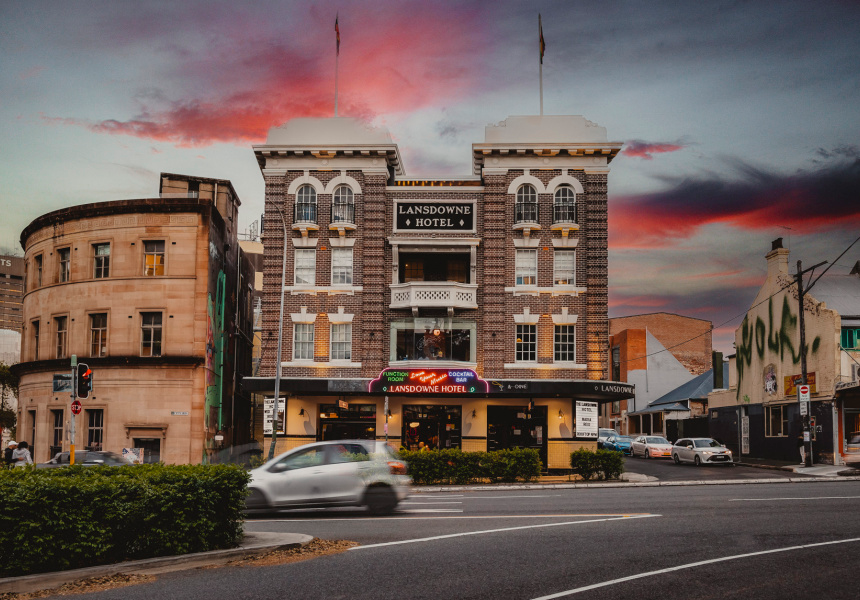
It fits the scientific brief remarkably well:
It’s elevated: The rooftop puts people up high, which is enough on its own to nudge heart rates and induce mild arousal, echoing the bridge-height effect in the Shaky Bridge study.
It features active engagement: The venue has a ping pong table, offering light, competitive physical activity that serves as a socially low-stakes way to get someone's pulse up before a conversation.
It allows for synchronized novelty: Conveniently, the rooftop features two parapet rooms — perfect for a stroboscopic light setup.
Which brings us to the psychedelic element of the night: hallucinating without substances.
A few years back, APS ran a stroboscopic light demonstration with a large group at the East Sydney Community Centre. From nothing more than flickering light against closed eyelids, people genuinely began to experience stroboscopically induced visual hallucinations (SIVH)—geometric patterns, tunneling visuals, and occasionally, complex imagery. No substances required.
This isn’t a fringe phenomenon. In the 1950s, neuroscientist William Grey Walter documented that flickering light on closed eyes could dramatically alter states of consciousness, sending visual cortex activity rippling into the wider cortex. In the 1960s, artist Brion Gysin built the "Dreamachine" based on these principles to induce altered states outside of an EEG lab. Contemporary work on the revived Dreamachine project and "Ganzflicker" paradigms continues to map these experiences, with participants reporting everything from simple color shifts to complex scenes, like fields of wheat or the faces of loved ones.
This is the piece that ties the evening directly back to the core mission of the APS: giving people access to genuinely altered, non-ordinary states of consciousness through evidence-based, harm-reduction-first methods. It requires no substances, is safe*, carries zero legal risk, and is grounded in real neuroscience.
Putting It Together
So with the team at the Lansdowne we booked the roof top and have started selling tickets!
None of this guarantees anyone will fall in love on the night. But it will give them, scientifically, the best possible chance. It is a dating experience designed from the evidence up, built on some of the most robust findings in the psychology of attraction, and delivered with a distinctly psychedelic-community sensibility.
Tickets and details for Psychedelic Date Night — Saturday 25 July at The Lansdowne Hotel, Chippendale, hosted alongside MC Jay Katz, are below.
https://events.humanitix.com/sydney-psychedelic-date-night
References
Dutton, D. G., & Aron, A. P. (1974). Some evidence for heightened sexual attraction under conditions of high anxiety. Journal of Personality and Social Psychology, 30(4), 510–517.
Meston, C. M., & Frohlich, P. F. (2003). Love at first fright: Partner salience moderates roller-coaster-induced excitation transfer. Archives of Sexual Behavior, 32(6), 537–544.
Walter, W. G. (1953). The Living Brain. Duckworth.
Ter Meulen, B. C., Tavy, D., & Jacobs, B. C. (2009). From stroboscope to dream machine: A history of flicker-induced hallucinations. European Neurology, 62(5), 316–320.
*An Important Safety Note: Stroboscopic light can trigger seizures in individuals with photosensitive epilepsy. This space will be clearly signposted and operates on a strictly opt-in basis; no one will wander into it unknowingly.